Building peace starts at home: inspiring families to act against gender-based violence in Burundi
Agathe Minani, a cross-border trader from Burundi, faced life with an emotionally abusive husband. The Mupaka Shamba Letu project supported her family to turn a corner, and now she and her husband are helping others in the fight against gender-based violence.
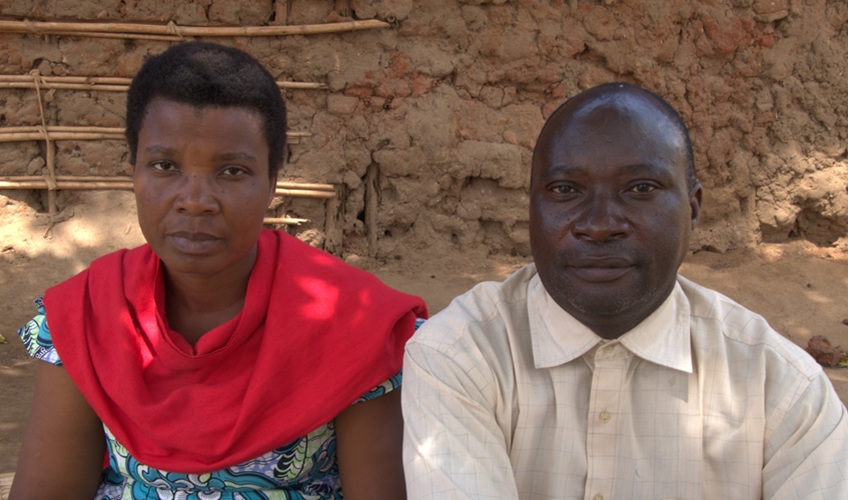
Every day, more than six thousand people cross the Gatumba border between Burundi and the Democratic Republic of Congo (DRC). The majority are women involved in small-scale cross-border trade. Agathe Minani is one of these traders.
Agathe begins her day at 5 am to buy fruits and vegetables in Burundi before crossing the border to sell them to retailers in the DRC. Security issues at the border mean that she faces the daily risk of harassment and exploitation. Yet despite the dangers and economic challenges of cross-border trade, this business has been the source of her family’s livelihood for more than 10 years.
In recent years, however, Agathe’s husband began subjecting her to verbal abuse and psychological violence. Her home became a place where she and her children no longer felt safe. It reached the point where she considered leaving her husband to return to her parents, an act regarded as extremely shameful in her family.
Agathe explains that at the market, she at least had a chance to smile and experience moments of joy. At home, she received only insults and emotional abuse.
“While doing business at the market, many times I saw the sun setting and wished the day would not end, not because I hoped to earn more profit, but because I feared going back home and facing what my husband used to inflict on me,” she says.
What saddened me the most was the shame in front of my children.
Agathe felt the weight of the traditional, restrictive expectations for women’s roles in the home. When the abuse became too much, she eventually began responding in ways she herself thought were disrespectful.
“For a long time, I kept silent and never replied to my husband’s insults. But when I started giving proportionate replies, the noise between us would wake the neighbours. They often came to our house to reconcile us,” she says. “What saddened me the most was the shame in front of my children.” She says she will never forget how she prepared small gifts for her children to distract them from the verbal fights between her and her husband.
“In the neighbourhood, it is still considered normal for some men to beat their wives. In my case, the verbal abuse and other misbehaviours I was receiving were even worse,” she adds.
Gakiza Du Bois, Agathe’s husband, became known in the village for the abuse he inflicted on his wife. He now openly acknowledges and regrets his actions, which he attributes to cultural norms and peer pressure.
“My wife’s business requires her to leave home early and return late,” he says. “Early in the morning, she would prepare breakfast for our children. Before her return, the children would be hungry. But because I believed that in our culture no married man can cook, I refused to prepare food – even though there was food available.”
He recalls how his wife’s questions about why he refused to cook angered him. He could not stand being questioned by a woman. “In my mind, doing domestic work, something considered a woman’s job, was like being submissive to a woman,” he adds. “It affected me psychologically as well. I remember refusing to eat after exchanging harsh words with my wife, simply because the food was provided by her. I would go to bed hungry.”
The conflict and distrust extended into every area of family life. Du Bois, who worked as a nursery schoolteacher, even refused to tell his wife how much he earned, because he feared she would want to control how he spent it. “There was no peace in our home”, he said.
There was no peace in our home.
This is a common tension for the families of cross-border traders. With women able to earn money, their husbands are required to take on more domestic responsibilities. Restrictive views on gender roles can therefore often be particularly harmful for women traders. The Mupaka Shamba Letu (“Our Border, Our Livelihood”) project, implemented by International Alert and local partners, supports families to work through these challenges.
One of its key pillars is educational work, in which husbands and wives discuss gender equality. The project’s educational sessions challenge gender stereotypes, promote positive masculinity and support dialogue between couples. Joining this process helps families foster mutual respect, shared decision-making and nonviolent communication.
Agathe invited her husband to join these sessions. He declined at first, but eventually accepted.
“My wife and others used to meet through the project. She told me that she sometimes felt anger because of my behaviour,” he says. After several sessions, he began noticing that their interactions had become kinder and their communication had improved. He credits the project with a significant change in their household.
Esther Furaha works with the Association des Femmes Rapatriées du Burundi (AFRABU), an implementing partner of Mupaka Shamba Letu in Burundi, and serves as the coach for participants at the Gatumba site. She explains that although the project focuses on women cross-border traders, the training on gender equality improved once the sessions included both women and men.
“Once we involved the husbands of our female participants, awareness about GBV was no longer one-sided. When we trained only women, there was no tangible change in households with GBV cases,” she says.
We urge people to avoid gender-based violence because it brings only misery to families.
Agathe and Du Bois say that once they reconciled and committed to ending GBV, their household was transformed. They began planning together and eventually opened a joint bank account. They jointly decide how to use their income, including for buying land and building a house. Du Bois now shares household responsibilities with Agathe – he cooks for his children and cleans the house when his wife is at work.
Today, the couple visit other families together and participates in community events. Their transformation has made them well-known in the neighbourhood, and they are often called upon to help reconcile couples experiencing GBV. They are also frequently invited to share their testimony and advise men on ending gender-based violence. “We urge people to avoid gender-based violence because it brings only misery to families,” says Du Bois.
Mupaka Shamba Letu has been gaining recognition for the support that it provides for cross-border traders and the impact this can have on the broader community. Masudi Nyabenda, Executive Secretary of Ntahangwa Commune in Bujumbura Province, where Gatumba is located, says any support that helps reduce GBV cases is a significant contribution. “Every year, we receive reports of GBV cases,” he says. “We do our best to reduce the numbers, and thanks to projects like Mupaka Shamba Letu, we can eliminate such cases.”
Mupaka Shamba Letu is implemented by International Alert in Burundi, the DRC and Rwanda, in collaboration with local partners, with funding from the Swiss Agency for Development and Cooperation (SDC) and the Swedish International Development Cooperation Agency (Sida). The project focuses on the economic empowerment of women involved in small cross-border trade, the strengthening of social cohesion in cross-border communities, and the inclusion of gender dynamics.