“The Lebanese people have a love for life”: Roula’s story
Roula Chami, 54, is a social worker from Beirut. She is part of a network of over 130 women changemakers that prevent and resolve local conflicts across the country.
Roula’s mother was killed as a casualty of war in 1984 when Roula was just 14 years old. Driven by her own experiences of loss through successive wars in Lebanon, Roula has been involved in conflict resolution and peacebuilding ever since she joined UN Women’s project “Women, Peace and Security in the Arab States” that International Alert implements in partnership with the Professional Mediation Center at University Saint Joseph.
In her own words, this is Roula’s story.
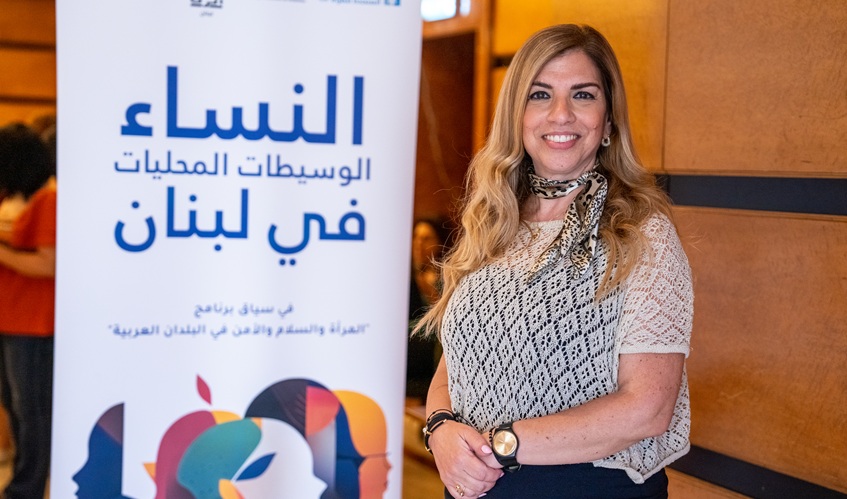
My background is in social work. I work with individuals, families, and groups. I’m driven to get directly involved on the ground, doing my part, and supporting marginalised people, especially those affected by war.
I have personal experience with war, not just this war, but the last war and previous wars. I lost my mother in the war. My experiences and witnessing the pain of the local community after the wars are what motivated me to take on roles that support people in the community.
I feel like it’s my character. It’s in my nature, because I’ve been through a lot of difficulties. I lost my mother when I was 14, so I was very young. I found strength in the support of my father, older sister, brother, and aunt, who stood by me during that difficult time
I was young and had to be strong – to survive.
I rely on myself and I’m not afraid.
Becoming a local woman mediator
I found out about this project (UN Local Women Mediators) from an invitation shared by the Syndicate of Social Workers. It was the first step on my path in the Women, Peace and Security project. The training included multiple sessions, and I learned skills such as conflict management, communication, and leadership. All of this training helped me understand the roles that women can play in the peacebuilding process.
As a local woman I can support my community and share what I have learned, understanding the differences between two groups that may be experiencing a particular conflict.
Making progress
In the Shiyah and Ain El-Rummaneh areas, sensitivities remain due to divisions that trace back to the civil war period, as no real reconciliation process has ever taken place between the communities. We were working with the local communities over long-standing tensions. We worked with young people from two different sects who have been in conflict for a long time, since the days of civil war. There is often disagreement between families. Conflict is passed from generation to generation.
I decided to go and to help my community on the ground. I was afraid. But I chose to move forwards.
Young people have enthusiasm, and before the war, this initiative worked very well. We created a safe space for dialogue where they could talk to each other. For youth from Shiyah and Ain El-Rummaneh and others to meet and to talk and to see past stereotypes. We created a space for dialogue sessions where they talked about their experiences. We were able to create trust between the youth and the community.
We had hoped that by working with young people we could break this cycle. But unfortunately, after the 2024 war, you feel that everyone has returned to their affiliations and beliefs. Going back to that area after the war, the challenges and the differences between the two communities have arisen again. They need support from mediators because they are frightened of each other again.
The 2024 war
When war broke out in 2024, we stopped working with children in schools and shifted our work towards emergency support.
In Beirut, there were schools acting as emergency shelters, hosting displaced people from South Lebanon and elsewhere. We went to the schools, assessed the needs of the people sheltering there, and started to distribute hygiene kits and some medical kits. I was the team lead of 16 social workers helping displaced people in different schools.
Unfortunately, we are used to war in Lebanon. I could see the level of anxiety in the people around me, how scared they were about their family and their children. If I could help my community, I didn’t have to sit at home and overthink about what could happen.
I decided to go and to help my community on the ground. I was afraid. But I chose to move forwards, I had this hope that better days were coming.
Post ceasefire
At the end of the war, the school where I work reopened to students. However, at night there was bombing. At night everyone in Lebanon was watching or seeing the bombing and at 8:00 AM, they needed to wake up and continue living as if nothing happened.
Sometimes there were bombings during the day, so we had a team that took the children to a safe place, and after one hour the children continued working normally and continued attending classes.
This is the culture of Lebanese people to keep moving, to keep working, as if nothing happened because we are used to all the conflicts and challenges throughout our past years.
I believe we are capable of spreading peace around us, in our homes, with our families, in our communities, and in our neighborhoods.
Hopes for the future
During the war in Lebanon, there was destruction, war, chaos, fear, and pain. But also, the Lebanese people have a love for life, a nobility that helps them overcome difficulties. They want to rise like a phoenix and come back to life because they are a people who love to live, they love to rejoice, they love to enjoy life, they love the whole world, they love their country, and they love this joy. Despite all the pain and all the hardships, the Lebanese people have a spirit that will never die.
Patience is everything, it is religion. We, as Lebanese people, are resilient and strong despite all the wars and all the hardships we have endured. We want to return to our lives with joy, happiness, and peace of mind.
The role of women in peacebuilding
We live in a male-dominated society where it is difficult for people to accept women beyond traditional roles. Men are often seen as more important than women. One big challenge is that women face a lack of financial support, which makes things even harder.
What helped me was support from a network of local women mediators. Through the local projects we did together, it helped break these barriers down, build trust and challenge the traditional stereotypes about women’s roles within their community.
Bringing about change is like a snowball, like a ball that gets bigger and bigger and bigger. We are influenced by the people around us, and I believe participation is the key to building a healthy society. Peace begins with each and every one of us. I believe we are capable of spreading peace around us, in our homes, with our families, in our communities, and in our neighborhoods.
The Women, Peace and Security project gave me the knowledge and skills to change something. It has helped women to be more effective in their community through dialogue, through communication, through understanding, through rethinking everything. All of these are skills that we are building, especially during the training and technical workshops. They helped us because we were able to achieve results. No matter how big, they make a difference.