Strengthening the role of women: family-based peacebuilding in South Lebanon
Families in South Lebanon are under immense strain. Conflict and prolonged economic hardship provide the backdrop for an ongoing displacement crisis – more than 90,000 people have had to leave their homes since late 2023, over half of them women and girls. Family structures, social stability and access to basic services have been undermined. While some families returned following the November 2024 ceasefire, increased tensions within families and communities have intensified the risk of gender-based violence (GBV).
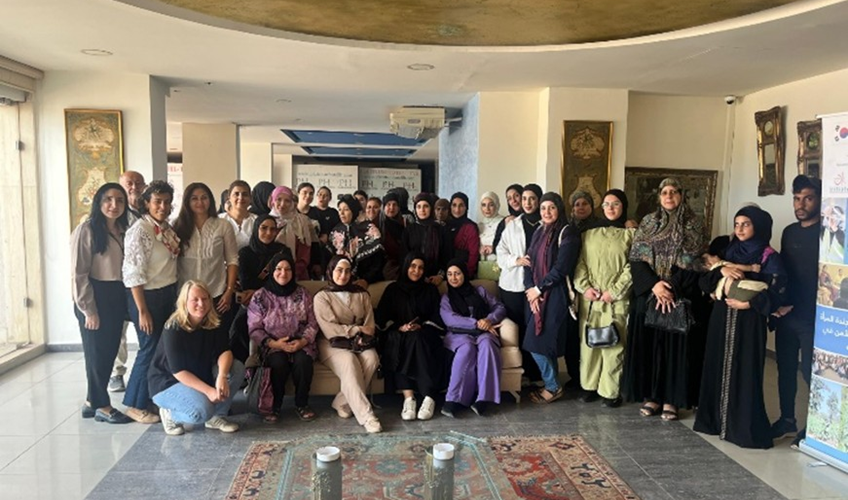
It is in this fragile context that International Alert, in partnership with UN Women, has been delivering a family-centred peacebuilding initiative in the districts of Tyre and Abbassieh, areas near the border with heightened security risks. Alert has engaged 198 members of the community – 150 women and 48 men – in a comprehensive series of trainings aimed at transforming harmful family dynamics, strengthening gender equality, and preventing GBV. The initiative recognized that family-level dialogue can complement more formal protection and justice mechanisms and as such can be a critical entry point for peacebuilding.
Transforming Family Dynamics
The project was guided by the Transforming Family Dynamics handbook, developed by International Alert as a practical tool designed to support local women mediators and community members in promoting peace and stability at the household level. The handbook focuses on strengthening women’s roles in fostering dialogue and understanding within households, and transforming gender relations and norms that contribute to inequality and violence.
By equipping women and families with gender-responsive tools and inclusive conflict-resolution strategies, the approach aims to enable women’s meaningful participation in peacebuilding, while strengthening community attitudes toward gender equality and non-violent conflict resolution.
The process began with a pilot phase in September 2025, bringing together 51 participants, including local women mediators, their families, and neighbours. Designed to reflect real household dynamics and lived community realities, the pilot allowed participants to test the handbook’s tools and methodologies in a safe, familiar setting.
Participants fed back on examples, case studies, and facilitation techniques, ensuring that the content resonated with the social, economic, and emotional pressures families face in South Lebanon today. The diversity of voices – across genders, generations, nationalities and family roles – helped shape a final methodology that responded to both gendered and intergenerational realities. As a result, the handbook emerged as a practical, context-sensitive resource, now available in Arabic and English.
Community Workshops
Building on the pilot, International Alert delivered six two-day community workshops in September and October 2025. Co-facilitated by five local women mediators, the workshops engaged an additional 147 participants from Lebanese, Palestinian, and Syrian families.
The sessions created inclusive spaces for families to explore roles, power relations, emotional boundaries, communication patterns, and the various forms of violence that can affect households, particularly women and girls. Through interactive exercises, violence analysis tools, and role-play grounded in everyday situations, participants reflected on behaviours that can fuel tension and inequality, while identifying practical strategies for non-violent communication, joint decision-making, and mutual support.
Men and young people, in particular, shared reflections on habits and communication styles they had never previously questioned. Women spoke openly – often for the first time in a group setting – about experiences of emotional and structural violence. Many participants reported initiating conversations at home after the first session, improving cooperation over household responsibilities, and adopting calmer, more respectful communication with spouses and children.
The intergenerational format brought together mothers, daughters, fathers, siblings, relatives, neighbours, and grandparents, and proved to be a crucial component for strengthening family stability. Participants noted that hearing each other’s perspectives reduced misunderstandings and increased empathy within households.
Equally significant was the inclusion of Lebanese, Palestinian, and Syrian families. Participants recognized shared challenges related to displacement, economic pressure, parenting stress, and family conflict. This mutual recognition helped break down stereotypes and foster solidarity in neighbourhoods where meaningful cross-community engagement is often limited, contributing to broader social stability.
Local women mediators were central to the success of the initiative. They supported facilitation and guided small-group discussions. Their involvement increased community trust in the process and further strengthened their own leadership capacities. They reported increased confidence, improved communication skills, and greater sensitivity to GBV-related risks, reinforcing their role as credible and trusted connectors within their communities.
Jumanah Zabaneh, UN Women’s Programme Management Specialist paid testament to the inclusion of women mediators in the sessions and their ongoing role in promoting peace in South Lebanon. “Women mediators in the South of Lebanon continue to demonstrate remarkable leadership, navigating a rapidly shifting context with agility, insight, and an unwavering commitment to community wellbeing,” she said. “They have been at the forefront of preventing and addressing gender-based violence, both within households and across entire communities. At a moment when external tensions and the threat of war risk deepening vulnerabilities, their leadership and mediation efforts are essential to preventing the escalation of violence against women.”
Shifts in Attitudes and Skills
Overall, the pilot sessions and the full series of community workshops supported families to better understand household power dynamics, communicate more constructively, and identify harmful behaviours that may escalate into gender-based violence. The sessions also contributed to inter-family and inter-community stability by encouraging dialogue across ages, genders, and nationalities.
Participants reported improvements in gender awareness, family dynamics, communication, and conflict management. Specifically, they identified some of the key changes as:
- Reduced stereotypical views of men’s roles
- Greater awareness of power inequalities within families and different forms of violence
- Stronger non-violent communication skills rooted in needs-based interactions and empathetic, collaborative decision-making
- Increased willingness to use mediation for community disputes
- Greater adoption of constructive conflict strategies, with a stronger emphasis on mutual agreement as the first step in resolving conflicts
- Increased recognition of local women mediators as trusted actors in community-level mediation and family-related prevention efforts
Self-assessments following the workshops showed that 76% of participants felt high confidence in managing family conflicts, while 96% expressed confidence in addressing community-level disputes. While some traditional norms persist, overall trends indicate growing empathy, collaboration, and proactive problem-solving.
A Story of Change
One powerful example emerged from a workshop bringing together Lebanese, Palestinian, and Syrian families. At the beginning, many participants sat separately, reflecting social distance and assumptions shaped by years of displacement and economic strain. By the end of the two-day workshop, the same group was sitting together, sharing personal stories of stress, discrimination, and family conflict, discovering striking similarities in their experiences. The exercises on power dynamics and emotional well-being created a safe space for empathy and solidarity to grow.
“I used to think our problems were unique,” one participant shared. “But I discovered that families from different backgrounds face the same pressures. This made me feel less alone and more connected.”
As this interaction shows, family-level dialogue and locally-led, gender-responsive facilitation can not only improve intra-family communication, but also strengthen inter-community stability and promote mutual understanding, even in one of South Lebanon’s most sensitive contexts.