Africa

Natural Resource Exploitation and Human Security in the Democratic Republic of Congo

Seminar Report
International Alert
Pole Institute
Junio, 2004
International Alert, Pole Institute
24 pages
London, UK
1-898702-51-9

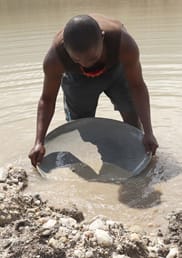
The Democratic Republic of Congo (DRC) is immensely rich in natural resources but its people are among the poorest in the world. This paradox is both cause and effect of the brutal exploitation of the country’s resources that has taken place since King Leopold, and that has fuelled such violent and devastating conflict.

The report is organised in three parts: first, summaries of the seminar presentations and plenary discussions; then analysis of the issues discussed and some conclusions; lastly a sketch of relevant policy actors and processes, with a view to further research and advocacy.

Publication Image

Práctica Empresarial Sensible al Conflicto: guía para la industria extractiva

International Alert
Septiembre, 2006
International Alert
217 pages
London, UK
1-898702-66-8

Herramienta de Evaluación de Riesgo e Impacto del Conflicto a Nivel Macro (ERIC-M)

Objetivo

Herramienta de Evaluación de Riesgo e Impacto del Conflicto a Nivel Macro (ERIC-M) suministra a las compañías una comprensión detallada de la situación de conflicto en un país determinado para permitirles realizar una evaluación de su impacto sobre las dinámicas del conflicto, así como las oportunidades de prevención del conflicto o prioridades para la promoción de paz.

Publication Image

The UN Peacebuilding Commission: A Chance to Build Peace More Effectively

The Case of Burundi
International Alert
Octubre, 2006
International Alert
14 pages
London, UK

Set up during 2006 with peacebuilding as its sole objective, the UN Peacebuilding Commission has the potential to use its intergovernmental voice to focus attention on the factors that could drive a renewal of conflict. In this light, Alert submitted recommendations in late 2006 on how the PBC could most effectively orientate its short and long-term support to the process of improving security and sustaining peace, for men and women, in Burundi. More widely, this publication also looks at the main challenges for the PBC and how it should focus its activities.

Recommendations on how the UN Peacebuilding Commission (PBC) could most effectively orientate its short and long-term support for men and women in Burundi.

Publication Image

Local Business Local Peace

The Peacebuilding Potential of the Domestic Private Sector
Jessica Banfield, Canan Gündüz, Nick Killick (eds.)
Julio, 2006
International Alert
584 pages
London, UK
1-898702-73-X

This publication makes the case that the local business community in conflict-affected countries can and should play a role in building peace. Linking up with other peacebuilding actors, and taking advantage of their own resources and skills, business communities should address socio-economic, security, political and reconciliation dimensions of peacebuilding. Section 1 is divided into 5 thematic chapters, and Section 2 contains 19 country case studies. Executive Summaries are also available in Spanish and French.

The local business community in conflict-affected countries can and should play a role in building peace by linking up with other peacebuilding actors, and taking advantage of their own resources and skills.

Publication Image

Mobilising the Ugandan Business Community for Peace

Scoping Study – Summary Report
International Alert
Octubre, 2006
International Alert
32 pages
London, UK

The ‘Mobilising the Ugandan Business Community for Peace’ scoping study project undertaken by International Alert and funded by Swedish SIDA, ran from October 2005-July 2006. The purpose of the research was to assess the potential of the private sector in Uganda to address Uganda’s conflicts and contribute to peacebuilding. It was also intended to lay the groundwork for any future SIDA/ International Alert work in this area.

The ‘Mobilising the Ugandan Business Community for Peace’ scoping study project undertaken by International Alert and funded by Swedish SIDA, ran from October 2005-July 2006. The purpose of the research was to assess the potential of the private sector in Uganda to address Uganda’s conflicts and contribute to peacebuilding.

Publication Image

Peacebuilding in Eastern DRC

Improving EU Support for Economic Recovery
Alison Thompson with Edward Bell
Noviembre, 2007
International Alert
32 pages
London, UK
978-1-898702-92-4

This report focuses on economic recovery as a central pillar of peacebuilding in eastern DRC and, in particular, the role of the European Commission in supporting such processes. It argues that the drivers of fragility and instability must be addressed if meaningful long term economic recovery is to be realised. The report is based on field work carried out in South Kivu and Ituri, and draws on research by Alert’s partner in Bukavu, CEGEC.

This report focuses on economic recovery as a central pillar of peacebuilding in eastern DRC and, in particular, the role of the European Commission in supporting such processes.

Publication Image

A Climate of Conflict

The Links Between Climate Change, Peace and War
Dan Smith
Janani Vivekananda
Noviembre, 2007
International Alert
44 pages
London, UK
978-1-898702-90-0

Climate change is upon us and its physical effects have started to unfold. That is the broad scientific consensus expressed in the Fourth Assessment Review of the Inter-governmental Panel on Climate Change. This report takes this finding as its starting point and looks at the social and human consequences that are likely to ensue – particularly the risks of conflict and instability.

This report looks at the social and human consequences that are likely to ensue from climate change,  particularly the risks of conflict and instability.

Publication Image

Building a Peace Economy in Northern Uganda

Conflict-sensitive Approaches to Recovery and Growth
International Alert
Septiembre, 2008
International Alert
65 pages
London, UK
NA

The attention and interest of the various stakeholders in rebuilding Northern Uganda’s economy as part of peace and recovery present critically important opportunities for positive change and a move to sustainable peace in the region, following years of economic decline and underdevelopment during the decades of conflict. But how strategic are these plans, given the challenges that persist, and when seen from a peacebuilding perspective? Are the opportunities to address root causes, immediate consequences, and ongoing threats of war being seized?

This briefing paper provides recommendations for conflict-sensitive policy and practice in northern Uganda, targeted at policy-makers and implementers in central and local government, as well as development partners (including NGOs) and private sector actors operating in the region.

Publication Image

Integrating women’s priorities into peacebuilding processes

Experiences of monitoring and advocacy in Burundi and Sierra Leone
International Alert
Noviembre, 2008
International Alert
24 pages
London, UK
978-1-906677-40-4

Women peacebuilders in various conflict-affected countries face very similar challenges as they attempt to integrate women’s interests in peacebuilding policy processes and civil society actors from different countries can potentially learn a lot from exchanging experiences with each other. This report outlines the findings and recommendations of a workshop with representatives from Burundian and Sierra Leonean civil society organisations working in the field of gender equality and women’s empowerment organised by International Alert on 25th to 29th February 2008.

This report outlines the findings and recommendations of a workshop with representatives from Burundian and Sierra Leonean civil society organisations working in the field of gender equality and women’s empowerment in February 2008.

Publication Image

Global Monitoring Checklist on Women Peace and Security

Afghanistan • Democratic Republic of Congo Nepal • Northern Ireland • Sri Lanka
GAPS-UK
Marzo, 2009
GAPS-UK
162 pages
London, UK
NA

The Global Monitoring Checklist is a pilot research project designed to contribute towards international understanding on women, peace and security efforts. It highlights relevant activities at the local and national level by women, civil society, national governments and the international community. It is not a comprehensive survey of all initiatives relating to women, peace and security; rather, it is a first step in gathering and collating information that links directly to UNSCR 1325 implementation.

This is a pilot research project designed to contribute towards international understanding on women, peace and security efforts. It highlights relevant activities at the local and national level by women, civil society, national governments and the international community.

Publication Image

Enabling Peace Economies through Early Recovery - Perspectives from Uganda

Jessica Banfield with Jana Naujoks
Abril, 2009
International Alert
46 pages
London, UK
8-955-8085-03-5

This series of four country case studies explores the ways in which the economic causes, drivers and impacts of conflict have been tackled in different ways in a number of conflict-affected countries where Alert works. The aim is to encourage cross-country learning, and inform what has become a vibrant international debate in the last few years on how to adapt economic development interventions to conflict contexts, to make them conflict-sensitive, and able to support longer-term peacebuilding.

This report - part of a series of four country case studies - explores the ways in which the economic causes, drivers and impacts of conflict have been tackled in Uganda.

Publication Image

Harnessing Oil for Peace and Development in Uganda

Jessica Banfield
Septiembre, 2009
International Alert
92 pages
London, UK
978-1-906677-45-9

This report examines the potential of Uganda’s newly discovered oil reserves and recommends increased transparency and principled leadership to promote broad economic opportunities of oil discovery for peace and development in Uganda. This discovery of oil, taking place within a context of a variety of tensions that exist on both sides of the DRC-Uganda border, represents a potential risk of conflict and presents a peacebuilding challenge for local communities, the government, private sector investors, donors and civil society.

This report examines the potential of Uganda’s newly discovered oil reserves and recommendations for increased transparency and principled leadership to promote broad economic opportunities of oil discovery for peace and development.

Publication Image

Refugees in Eastern DRC

A Discussion Document
International Alert
Enero, 2010
International Alert
10 pages
London, UK

Inter-community violence and successive wars and rebellions have caused large-scale displacement of populations in the Great Lakes region of Africa. And when refugees and internally displaced people return, that can be the pretext for further outbreaks of violence. The displacement of people and also their return can often be exploited by political interests, and even if the people themselves are not being manipulated, rumours and false information can be orchestrated to heighten fears and tensions between communities.

This short report looks at the risks associated with the return of refugees and displaced people in eastern DRC, and action that should be taken to mitigate these.

Publication Image
Contenido sindicado